
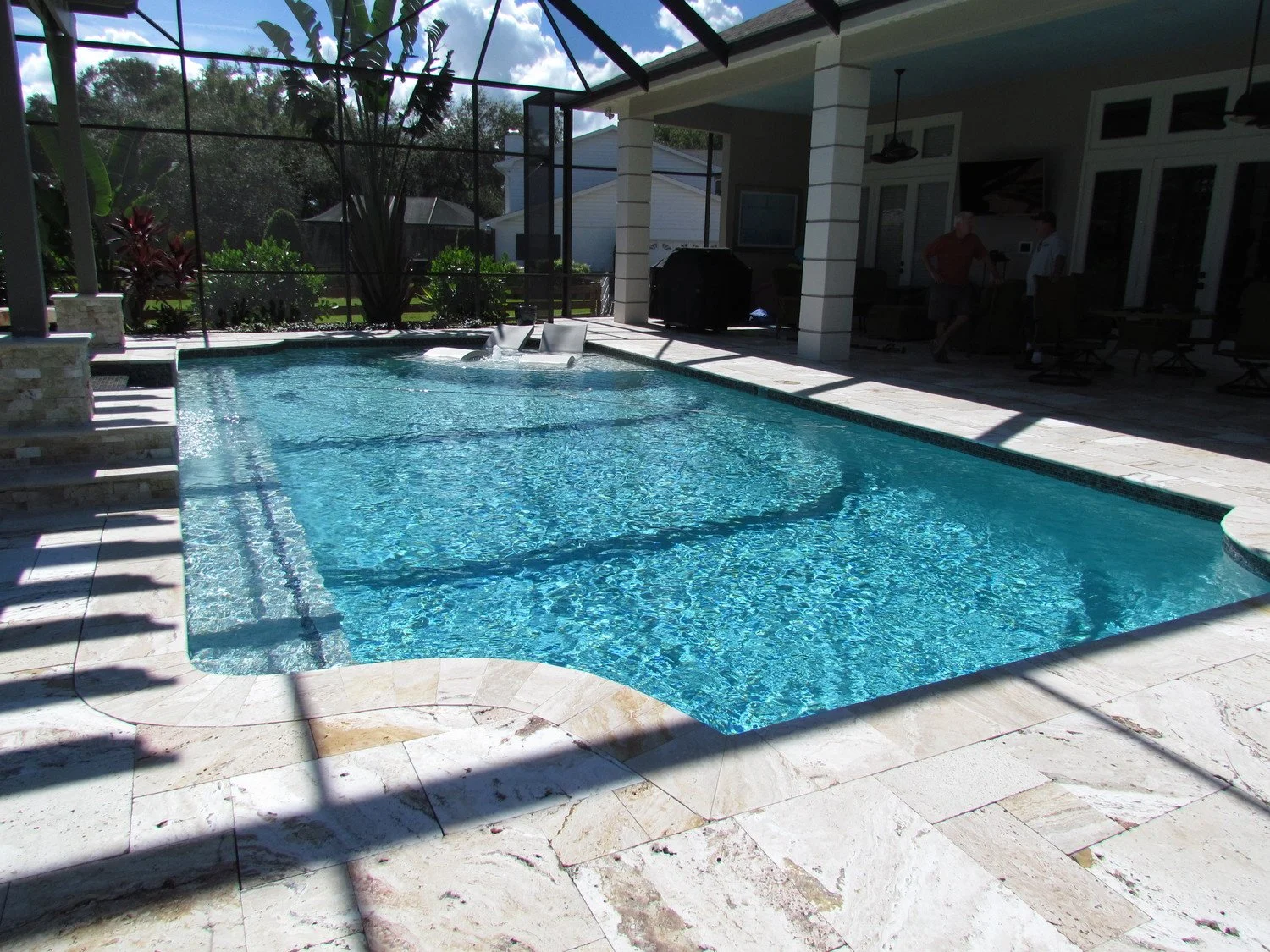

Pool Leak Detection & Repair in Clearwater, FL
Pressure Testing, Dye Testing & Electronic Leak Detection. Pool Shell, Skimmer, Plumbing Lines, Equipment Pad & More. No Trip Fee. Owner-Operated. Open 7 Days, 9am–9pm.
Every pool loses some water — to evaporation, splash-out, and backwash. But when your pool is dropping more than a quarter inch a day, needs constant top-ups, or you can't explain where the water is going, you have a leak. Left undetected, even a slow pool leak can cost hundreds of dollars per month in wasted water and added chemicals, undermine the soil beneath your deck, and cause progressive structural damage to the pool shell and surrounding hardscape.
Dog Days Pools finds and fixes pool leaks across Clearwater, Safety Harbor, Dunedin, Palm Harbor, Oldsmar, Countryside, East Lake Woodlands, and Lakeridge. We use pressure testing on plumbing lines, dye testing for shell and fitting leaks, and methodical on-site inspection to pinpoint exactly where water is being lost — then we repair it. Detection and repair from the same company, same technician, same visit when possible. No trip fee. No diagnostic charge. A clear quote before any work starts.
Clearwater's Pool Leak Specialists
Pressure, Dye & Electronic Detection
All three methods, matched to where the leak is
Detection + Repair — One Company
No need to hire separate detection and repair contractors
No Trip Fee. Free Estimates.
Quote before any work — always
20+ Years Clearwater Pool Experience
#1 rated in Clearwater & Safety Harbor, 6 consecutive years
Open 7 Days, 9am–9pm
Evenings and weekends — no overtime
Licensed & Insured #CPC1460480
State of Florida Certified Pool Contractor
How to Tell If Your Pool Is Leaking — vs. Normal Water Loss
Pools lose water every day from evaporation, splash-out, and backwash. In Florida's heat and sun, evaporation alone can account for ⅛ to ¼ inch of water loss per day — sometimes more during dry, windy stretches. That makes it genuinely hard to tell normal loss from a leak without a test. Here are the signs that point specifically to a leak rather than evaporation:
- Pool dropping more than ¼ inch per day consistently — especially when the pump is off
- Water level drops faster when the pump is running than when it's off (pressure-side or return-line leak)
- Water level drops at the same rate whether the pump is on or off (structural or gravity-based leak)
- The pool requires a top-up more than once a week during normal weather.
- Water bill spiking — thousands of gallons per month can be lost through a small crack.
- Autofill is running constantly, masking the actual rate of water loss.
- Pump loses prime repeatedly — suction-side air leak drawing air instead of water
- Air bubbles streaming from return jets when the pump is running
- The equipment pad is constantly wet, with puddles forming near the pump or filter
- Dripping or weeping from union fittings, valve collars, or pipe connections
- Pump basket not filling fully with water at startup
- Pressure gauge reading lower than normal without explanation
- Soft, soggy, or waterlogged soil near pool edge, along plumbing runs, or around equipment pad
- Pavers, coping stones, or deck concrete shifting, sinking, or cracking
- Visible cracks in pool shell plaster, especially near returns, lights, or main drain
- Tiles cracking, loosening, or falling off — especially near the waterline
- Skimmer pulling away from pool wall — gap forming between skimmer throat and pool shell
- Erosion or sinkholes forming in landscaping adjacent to the pool or equipment run
- Chemistry is constantly out of balance — fresh water dilution from constant top-ups disrupts chemistry
- Algae growing persistently in one specific area despite treatment (leak providing constant fresh water)
- Dirt or debris is being pulled into the pool through a structural crack or fitting gap.
- Chlorine demand is unusually high — losing treated water and constantly replacing it with untreated water
Noticing any of these? Call (727) 205-0566 — no trip fee, honest diagnosis, 7 days a week.
The Bucket Test — Confirm You Have a Leak Before Scheduling Service
Before spending money on a professional inspection, do the bucket test. It's a simple 24-hour test that separates normal evaporation from an actual leak. Blue Science recommends it on their own page — and so do we. If the bucket test confirms a leak, call us, and we'll take it from there.
Get a 5-gallon bucket and a marker
Any bucket works — a 5-gallon Home Depot bucket is ideal. You'll also need a permanent marker or waterproof tape to mark two water levels.
Place the bucket on your pool's first step
Set the bucket on the pool step submerged to about 3–4 inches of depth — enough that the bucket is sitting in pool water but not floating away. If your pool has no step, use a brick to weigh the bucket on the floor of the shallow end.
Fill the bucket to match the pool water level
Add water to the inside of the bucket until the water level inside the bucket matches the water level of the pool. Both surfaces should be at the same height. Mark the inside of the bucket at this level with your marker.
Mark the outside of the bucket at the pool's waterline
On the outside of the bucket, mark where the pool's current water surface is. This is your reference point for the pool's level — you need to be able to read this mark after the test is complete.
Run equipment normally for 24 hours
Let the pump and filter run on its normal schedule. Don't add water, don't swim, don't run the autofill. Let it sit for exactly 24 hours under normal operating conditions.
Read the results
After 24 hours, compare two things: (A) how much the water level inside the bucket dropped, and (B) how much the pool's water level dropped relative to the outside mark on the bucket.
Pool dropped SAME amount as bucket
Both water surfaces dropped by the same amount. The loss is explained by evaporation — the bucket and pool experienced the same evaporative conditions. You likely don't have a leak. Monitor for a few more days if you're not fully convinced.
Pool dropped MORE than bucket
The pool lost more water than the bucket did through evaporation. The difference is unexplained water loss — you have a leak. The bigger the difference, the larger or more active the leak. Call us at (727) 205-0566.
Bucket test refinement — pump on vs. pump off
Once you've confirmed a leak with the bucket test, you can learn something about where the leak is by running the test a second time with the pump off. Fill the bucket again, mark both levels, and let the pool sit for 24 hours with all equipment off.
Pool drops MORE with pump running than pump off → likely a pressure-side or plumbing leak — water is escaping when the system is pressurized
Pool drops the SAME whether the pump is on or off → likely a structural or gravity-fed leak — shell crack, light fitting, skimmer collar, or fitting that lets water escape passively.
Pool drops LESS with pump running than pump off → rare, but can indicate a suction-side leak that actually draws water in when not pressurized
Where Clearwater Pools Actually Leak
Not all pool leaks are in the same place, and the detection method depends entirely on where the leak is. Here are the five most common leak locations in Clearwater pools — ranked roughly from most to least common based on 20+ years of service in the area:
Equipment Pad & Above-Ground Plumbing — Most common first place to check
The equipment pad — the area where the pump, filter, heater, salt system, and all the PVC connections live — is the most frequently found source of pool water loss, and it's the first thing we inspect on any leak call. Union fittings, valve collars, pump lid o-rings, filter band clamps, heater connections, and salt cell unions all develop leaks under the daily cycle of operating pressure. Many equipment pad leaks drip slowly and are only obvious when the pump is running — small enough to not form a visible puddle but large enough to lose significant water over weeks.
- Union fittings at every piece of equipment — o-ring failure causes weeping or dripping at the connection under operating pressure
- Pump lid and strainer housing — cracked lids or deteriorated lid o-rings cause both water loss and air ingestion
- Filter band clamp and tank o-ring — the band holding the filter halves together can loosen; the tank o-ring can fail
- Multiport valve on sand and DE filters — gasket and spider gasket failures cause internal and external leaks
- Salt cell unions — especially common at Hayward AquaRite cell connections, which experience chemical stress
- Valve stem o-rings — ball valves and gate valves leak from the stem collar when o-rings degrade
Skimmer & Skimmer Collar — Very common in Florida's older pool stock
The skimmer is one of the most common structural leak sources in Clearwater pools. The skimmer body is a plastic or ABS housing embedded in the pool wall, and over time, the bond between the skimmer body and the pool's gunite or plaster shell weakens and separates.
- Skimmer body separation from pool shell — gap forms between plastic skimmer housing and gunite
- Skimmer throat fittings — connection between skimmer and underground suction pipe
- Detection method: Dye testing — inject pool dye at the joint
Pool Lights & Light Fittings — Often overlooked, easy to miss
Pool light niches are cast directly into the pool shell and create a penetration through the gunite that must be perfectly sealed.
- Light niche and shell interface cracks
- Light conduit seal failure
- Light fixture gasket leaks
Return Fittings, Main Drain & Other Shell Penetrations
Every fitting embedded in the pool shell creates a penetration that must remain sealed.
- Return jet fittings separating
- Main drain frame cracks
- Handrail anchors causing leaks
- Spa jet fitting leaks
Underground Plumbing Lines — Hardest to find, most expensive to repair
Underground plumbing leaks are the most difficult to locate and repair because they are buried beneath soil, deck, or concrete.
- Suction line cracks or joint failures
- Return line failures
- Skimmer-to-underground connection failures
- Main drain line failures
How We Find Pool Leaks — The 3 Detection Methods
Professional leak detection uses three distinct methods — each suited to a different type of leak. We use the method that matches what the symptoms and location suggest, and often combine methods when the leak source isn't immediately clear from inspection alone.
Pressure Testing — For Plumbing Line Leaks
The most reliable method for diagnosing underground plumbing leaks. Each plumbing line — suction lines from skimmer and main drain, return lines to each jet, any dedicated spa or cleaner lines — is isolated by plugging both ends and applying controlled air or water pressure. The system is monitored over time: a line that holds pressure is intact; a line that loses pressure has a crack, joint failure, or fitting separation somewhere along its run.
- Which specific line is failing — suction or return, which return, which skimmer
- Severity of the loss — slow leak vs. significant pressure drop
- Whether multiple lines have issues or just one
This data, combined with the pool's plumbing layout, narrows the likely excavation point before a single shovel goes into the ground.
Dye Testing — For Shell, Fitting & Skimmer Leaks
Dye testing pinpoints the exact location of structural leaks — cracks in the pool shell, gaps at fittings, skimmer separations, light niche failures, and grout line failures. A small amount of pool dye (a harmless, pool-safe dye) is carefully injected near a suspected leak point with the pump off and water still. If a leak is present, the dye is drawn through the water toward the gap and pulled into it, making the leak point visible as the dye disappears rather than dispersing evenly through the pool water.
- Suspected skimmer separation — inject dye at the joint between the skimmer housing and the pool shell
- Return fitting gaps — dye applied around fitting eyeball while pool is still
- Light niches — dye around the light gasket perimeter and at the niche-to-shell interface
- Plaster cracks — dye applied at the crack to confirm it is a through-crack losing water vs. a surface-only cosmetic crack
Visual Inspection & Electronic Listening — For Surface & Hard-to-Reach Leaks
A methodical visual inspection of the equipment pad under operating pressure, all above-ground plumbing, union fittings, valve connections, and the pool shell waterline is always the starting point — it finds a large percentage of leaks without requiring any testing equipment at all. For underground leaks that pressure testing has confirmed but not precisely located, electronic listening equipment detects the acoustic signature of water escaping under pressure from a buried pipe. This allows us to narrow the likely excavation point before digging, reducing the amount of deck or pavement disturbance.
- Wet mineral deposits and staining at union fittings, valve collars, and pipe connections
- Active drips at equipment pad connections under pump operating pressure
- Skimmer separation gaps, coping cracks, and visible shell damage at and below the waterline
- Soft ground, displaced pavers, or sinkholes indicate an underground water path
Pool Leak Repair — What We Fix
Detection tells you where the leak is. Repair seals it. Dog Days Pools handles both — you don't need to hire a separate leak detection specialist and then find a different contractor to fix what they found.
Equipment Pad Leak Repair
The most common pool leak repairs — union o-ring replacements, valve stem o-rings, pump lid o-rings, filter band clamps, and equipment plumbing fittings — are above-ground repairs we complete in a single visit. We carry common union sizes, o-ring kits, and PVC fittings as standard truck stock. Most equipment pad leak repairs are completed the same day.
Pool Light & Conduit Leak Repair
Light gasket replacement is the simplest light leak repair — the gasket between the light lens and the niche is replaced when the pool water level is dropped below the light. Light niche cracks are repaired with hydraulic cement or pool-grade epoxy applied to the crack with the pool at a lower water level. Light conduit seal failure — where the conduit running through the pool shell is the water path — is addressed by resealing the conduit entry point at the pool shell, typically requiring access to the conduit at the equipment pad end.
Skimmer Repair & Skimmer Collar Sealing
Skimmer separations are repaired using pool-grade hydraulic cement or two-part epoxy injected into the gap between the skimmer housing and the pool shell. For minor separations, this is a straightforward repair that requires no pool drainage. For significant structural failure where the skimmer body has fully separated, or the surrounding plaster has collapsed, skimmer replacement is the right call — this involves excavating the skimmer area from outside the pool wall, removing the old skimmer, and setting a new one with proper bonding and waterproof sealing before replastering.
Shell Crack Repair & Fitting Resetting
Structural cracks in the pool shell, plaster, and gunite are repaired with hydraulic cement for active leaks — the cement sets and expands against water pressure — followed by pool-grade plaster patching to match the surrounding finish. Return fittings that have separated from the wall are reset with pool-grade epoxy and replastered at the fitting collar. Main drain frames that have cracked or separated are repaired with hydraulic cement and, when necessary, drain frame replacement.
One Company — Detection and Repair Together
When you hire a leak detection specialist to find the leak and then need to find a separate pool contractor to repair it, you often lose the diagnostic context — the repair contractor didn't see the detection results firsthand and starts from scratch. Dog Days Pools finds and fixes leaks. The same person who runs the pressure test and interprets the dye results is the one who makes the repair, with full understanding of exactly where the water was going and why. That continuity matters for repair quality.
Underground Plumbing Repair
After pressure testing identifies the failing line and electronic listening helps narrow the location, we excavate only what's needed to access the leak. The failing section of PVC pipe or joint is repaired or replaced using pool-grade PVC and appropriate fittings, glued with pool-system-rated solvent cement, and allowed to cure before the line is pressure-tested again to confirm the repair holds. The excavated area is then backfilled and the surface restored. For lines where the failure point is beneath concrete deck or pavers, we discuss the restoration approach before any excavation begins — you know exactly what to expect before a single square foot of surface is disturbed.
Why Clearwater Pool Owners Choose Dog Days for Leak Detection
Blue Science Leak Detection Is Not Currently Available in Clearwater
Blue Science has a dedicated leak detection page for Clearwater, but the page itself states that leak detection is not available at this time in your location. For Clearwater pool owners who find Blue Science in search results for pool leak detection, the service they're looking for isn't available. Dog Days Pools performs leak detection in Clearwater with no trip fee, seven days a week, owner-operated.
No Trip Fee — Leak Wizard and Blue Science Both Have Service Call Costs
Leak Wizard provides upfront estimates but does not advertise a no-fee diagnostic. Blue Science starts leak detection at $599 (when available). Dog Days Pools does not charge a trip fee or a diagnostic fee. We come to your pool, run the bucket test comparison, inspect the equipment pad, and tell you what we find. You only pay when you approve actual repair work. On a leak that turns out to be an $80 union o-ring, the difference between paying and not paying a diagnostic fee before that repair is a significant portion of the total bill.
We Do Both Detection and Repair — Leak Wizard Only Does Plumbing
Leak Wizard is a dedicated plumbing and underground leak specialist — their expertise is in underground pipe repair, suction line repair, and return line repair. That's a strong specialty. But it doesn't cover the full picture: equipment pad leaks, skimmer collar failures, light fitting leaks, shell cracks, and fitting separations are not its focus. Dog Days Pools covers the complete range of where Clearwater pools actually leak — above-ground plumbing, shell, skimmer, lights, and underground lines. One call, one company.
Clearwater-Based, 20+ Years, #1 Rated for 6 Years Running
Dog Days Pools is based in Clearwater. Leak Wizard is based in the Tampa area with Clearwater coverage. When you call Dog Days, you reach the owner, Larry, who has 20+ years of Clearwater pool experience and has been rated the #1 pool service in Clearwater and Safety Harbor for six consecutive years by Three Best Rated. Pool leak diagnosis requires local pattern knowledge — which neighborhoods have the oldest pool stock, which plumbing configurations are common in each era of construction, and which types of pool shells leak in predictable places. That knowledge comes from working in the same area for two decades.
Open Evenings and Weekends — Leaks Don't Wait for Monday
Fresh Finish Pools is open Monday through Friday, 9am to 5pm. If you discover your pool is dropping water over the weekend, that's two days of continued water loss, worsening soil erosion, and climbing water bills before most pool companies answer the phone. Dog Days Pools is open seven days a week from 9am to 9pm. Call on a Saturday morning when you notice the pool is down three inches. We answer.
Pool Leak Detection & Repair Service Area
Dog Days Pools performs pool leak detection and repair across Clearwater and the surrounding Pinellas County area:
Our Primary Service Areas:
📍 Clearwater —Our home base — we know every neighborhood
📍Safety Harbor —Full-service pool care for Safety Harbor residents
📍Dunedin — Reliable weekly and repair service in Dunedin
📍Palm Harbor —Trusted pool pros throughout Palm Harbor
Also Serving:
📍 Oldsmar — Our home base — we know every neighborhood
📍Countryside — Experienced pool care for Countryside homeowners
📍East Lake Woodlands — Expert pool maintenance in East Lake Woodlands
📍Lansbrook — Regular service and repairs throughout Lansbrook
Not sure if we cover your street? Call (727) 205-0566 — we confirm coverage and give you a free estimate on the same call.
Call now to get a Free Estimate.
Call or Text
(727) 205-0566Hours
Monday – Sunday: 9am to 9pmServing all of Pinellas County
Pool FAQs — Clearwater, FL
Straight answers to the questions Clearwater pool owners ask most about pool timer repair, plumbing, valve issues, and leak detection.
Pool Losing Water? Let's Find It and Fix It — No Trip Fee
Whether you've done the bucket test and confirmed a leak, you're watching the water drop and can't explain it, your pump is losing prime, or you have wet ground around the equipment pad — Dog Days Pools is ready to help. We serve all of Clearwater and Pinellas County seven days a week from 9am to 9pm, with no trip fee and no diagnostic charge.
Call or text Larry directly. A straight assessment and a clear quote before any work starts.